The City View: August Update

Hope everyone has had a wonderful summer. Our market has officially entered uncharted territory. Single-family homes are now selling for an average of roughly 26% over asking, and headline-grabbing sales prices are becoming the norm. Homes selling $1 million over asking have become almost routine, rather than remarkable. This is driven by AI wealth pouring into the city and inventory that's shrunk by more than half compared to last year. Buyers aren't just competing against each other; they're bidding against a shrinking pool of listings and the fear of missing out.
Whether this frenzy has staying power is the question on everyone's mind. Rising mortgage rates, an eventual cooling in tech hiring, or a shift in IPO timelines could all take some air out of the market — and history shows SF real estate has never been shy about swinging from boom to correction. For now, sellers are in the driver's seat and offer prices that would have seemed unthinkable a year ago, might not even get you the home.
Sellers Keep the Upper Hand
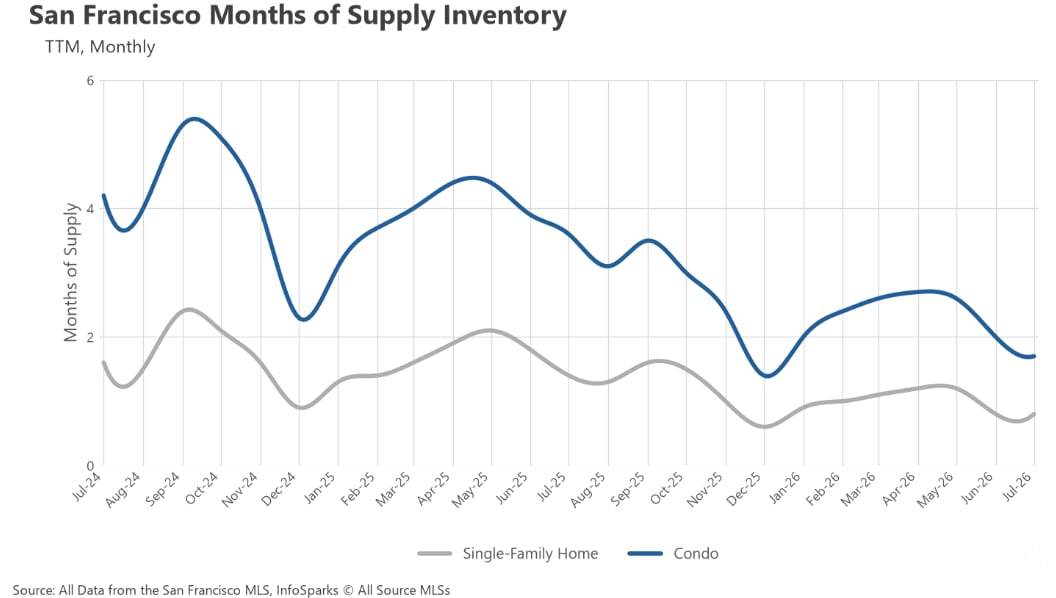
When determining whether a market is a buyers’ market or a sellers’ market, we look to the Months of Supply Inventory (MSI) metric. The state of California has historically averaged around three months of MSI, so any area with at or around three months of MSI is considered a balanced market. Any market that has lower than three months of MSI is considered a seller’s market, whereas markets with more than three months of MSI are considered buyers’ markets.
San Francisco sits firmly in seller's market territory on both fronts. Single-family homes carry just 0.8 months of supply, unchanged from June and down 42.86% from 1.4 months last July. At the current sales pace, every available single-family home in the city would be gone in roughly 24 days. Condos, meanwhile, have moved from a balanced market to a clear seller's market over the past year, dropping from 3.6 months of supply last July to 1.7 months now, a 52.78% decline and the lowest reading since December.
The significance here is that the condo segment, which spent most of 2024 and early 2025 above four months of supply, no longer offers buyers the negotiating room it once did. With both property types under two months of supply, faster sale times, and above-asking premiums holding firm, sellers retain substantial leverage heading into the fall.
Stay up to date on the latest real estate trends.


You’ve got questions and we can’t wait to answer them.